Selling surgical instruments to European hospitals from outside the EU: what 5,451 tender awards show
98.4% of European public awards for surgical instruments went to locally registered firms. Who wins, and what a distributor needs from a non-EU maker.

Marta Zielińska · Market research
5 November 2026 · 8 min read
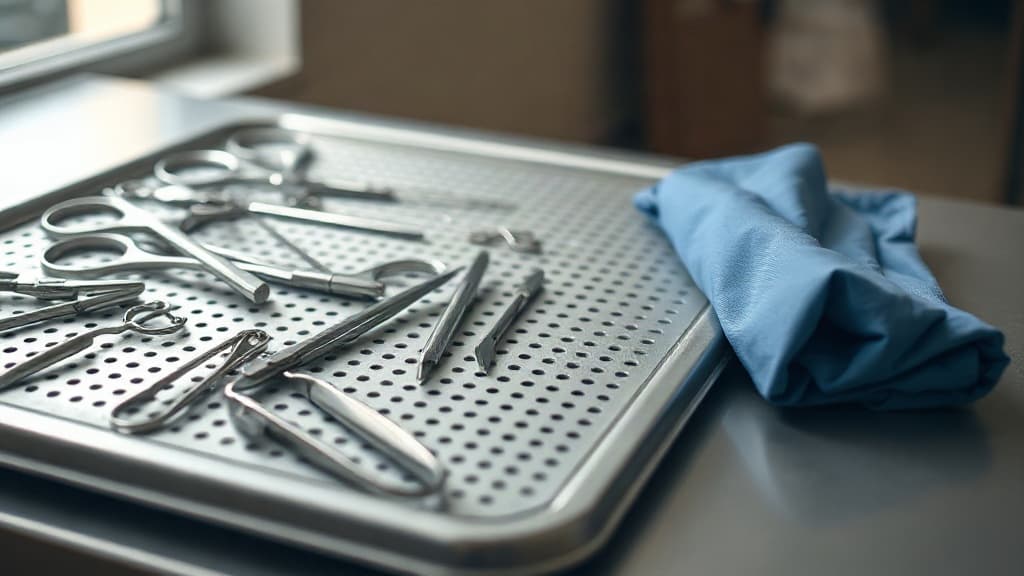
Many makers of surgical instruments in Sialkot, India, Turkey and China look for European partners the same way: a list of hospital suppliers, a catalogue, an e-mail to hundreds of addresses. Replies are rare. The reason is not the quality of the forceps. It is the way European public hospitals buy, and the paperwork a European company needs before it can sell a non-EU product.
Putting it simply: European public hospitals buy surgical instruments almost entirely from companies registered in their own country. Over three years, none went to a company registered in Pakistan, India, China or Turkey. Your instruments can still reach those hospitals through a local distributor that already wins tenders. Before it will list you, you need CE marking under the EU Medical Device Regulation, an authorised representative in the EU, and an importer.
What 5,451 awards show
Cresques counted the TED contract award notices for surgical instruments (CPV 33169000 and its sub-codes) with an award date between 1 November 2023 and 5 November 2026. That gives 5,451 awards to 1,174 companies, from public buyers in 26 European countries.
98.4% of the awards went to a company registered in the buyer's own country. The other 85 went almost entirely to companies from another EU country or from Switzerland: Boston Scientific Nordic AB from Sweden won 16 awards in Denmark, MAC's Medical Handels GmbH from Austria 6 in Slovenia, PETERS SURGICAL from France 4 in Belgium, Landanger from France 4 in Poland. Seven went to Swiss-registered companies such as Intuitive Surgical Sàrl, one to a UK-registered company.
Companies registered in Pakistan, India, China or Turkey won none.
That does not mean hospitals use no instruments made there. A notice names the company that signed the contract, not the factory. A local supplier can deliver instruments made anywhere, if they are lawfully on the EU market. The data says who the hospital buys from.
By country
| Buyer country | Awards | Winning companies | Buyers | Local winner |
|---|---|---|---|---|
| Poland | 1,515 | 235 | 154 | 99.2% |
| Romania | 932 | 128 | 61 | 100% |
| Lithuania | 645 | 79 | 11 | 99.2% |
| Spain | 415 | 149 | 35 | 99.8% |
| Portugal | 375 | 55 | 7 | 98.7% |
| Denmark | 216 | 32 | 5 | 91.2% |
| Czechia | 202 | 80 | 29 | 99.0% |
| Croatia | 149 | 25 | 4 | 99.3% |
| Slovenia | 145 | 30 | 3 | 92.4% |
| France | 140 | 71 | 12 | 96.4% |
| Italy | 105 | 47 | 27 | 99.0% |
| Estonia | 82 | 23 | 6 | 93.9% |
| Sweden | 60 | 39 | 10 | 93.3% |
| Germany | 55 | 18 | 20 | 100% |
| Belgium | 54 | 17 | 6 | 88.9% |
Read the small numbers for Germany and France with care. Both put few medical awards on TED: across all medical equipment (CPV 331), Germany has 3,892 awards in the same period and France 15,182, against 130,765 for Poland. Instruments bought inside lots coded only as general medical equipment are not counted here, so a low figure shows how little reaches TED under this code, not a small market. Poland, Romania and Spain publish the most awards under this code, which makes them the easiest markets to study. In Lithuania, Portugal, Croatia and Slovenia a handful of buyers account for hundreds of awards, so one relationship matters a great deal.
Only contracts above the EU thresholds must appear on TED. From 1 January 2026 that is EUR 216,000 for most hospitals (sub-central buyers) and EUR 140,000 for central government bodies (Delegated Regulation (EU) 2025/2152). Smaller purchases are published only nationally.
Who wins: often your competitors
In Poland the top three are Aesculap Chifa Sp. z o.o. with 192 awards (B. Braun's Polish company), Medtronic Poland with 98 and KARL STORZ Polska with 63. In Romania, MEDTRONIC ROMANIA leads with 66, followed by RAFI MEDICAL with 64 and ALPHA NED 2000 EXIM with 44. In Spain, Abex Excelencia Robótica has 68, Medtronic Ibérica 21 and the Spanish branch of Applied Medical Distribution Europe 20.
Several of these are the local sales companies of large manufacturers. They sell their own group's instruments, so they are your competitors, not your partners. The independent distributors that could carry your range sit among them and further down the list: in Poland, the distributor Beryl Med is fourth with 54 awards. Read each company's website: does it present brands from several makers, or one group's products only?
What you need before a distributor will list you
A European distributor that sells to hospitals checks the regulatory file before it looks at your price list. It has to: before making a device available, it must verify the CE marking, the EU declaration of conformity, the information supplied with the device and, where applicable, the UDI (Article 14 of the Medical Device Regulation (EU) 2017/745, the MDR). The points below reflect the MDR as in force on 5 November 2026.
1. The right class and conformity route
Most surgical instruments fall under rule 6 of Annex VIII (surgically invasive, transient use), where the default is class IIa. A reusable surgical instrument is class I: an instrument for cutting, drilling, sawing, scratching, scraping, clamping, retracting, clipping or similar procedures, without a connection to an active device, intended to be reused after cleaning, disinfection and sterilisation.
- Reusable instruments (often called class Ir) still need a notified body, limited to reuse: cleaning, disinfection, sterilisation, maintenance, functional testing and the related instructions for use (Article 52(7)(c)). Sterile class I devices need one for the sterile aspects (Article 52(7)(a)).
- Single-use instruments, such as a disposable scalpel, are normally class IIa: a notified body assesses your quality management system and the technical documentation of at least one representative device in each category (Article 52(6)).
Under the old directive, reusable instruments were usually self-certified. The transition to 31 December 2028 covers only devices whose declaration of conformity was drawn up before 26 May 2021 and whose manufacturer, among other conditions, had a quality management system and had applied to a notified body by 26 May 2024 and signed an agreement by 26 September 2024 (Article 120(3b) and (3c), as amended by Regulation (EU) 2023/607). A manufacturer starting now needs a full MDR certificate.
2. An authorised representative and an importer
"Where the manufacturer of a device is not established in a Member State, the device may only be placed on the Union market if the manufacturer designates a sole authorised representative" (Article 11(1)). The representative accepts the mandate in writing, checks your declaration and technical documentation and, where you have not met your obligations, is jointly and severally liable for defective devices (Article 11(5)), so expect it to read your file before it signs.
The EU company that first places your device on the market is the importer. It must run its own checks, put its name and address on the device, its packaging or an accompanying document, and check the Eudamed registration (Article 13(2) to (4)). Your distributor may act as importer or buy from one. Agree in writing who does what.
3. Eudamed, UDI and language
Commission Decision (EU) 2025/2371, published on 27 November 2025, confirmed that four Eudamed systems are functional. The related obligations apply six months after publication, from 28 May 2026 (Article 123(3)(d) MDR, as amended by Regulation (EU) 2024/1860), and manufacturers must enter their device data by 27 November 2026, including for devices they keep placing on the market (Article 123(3)(e)). UDI carriers on the label have been required for class I devices since 26 May 2025 (Article 123(3)(f)). Labels and instructions, including reprocessing instructions, must be in the language set by the Member State where the device reaches the user (Article 10(11)).
This is a summary of the regulation, not regulatory advice. Check your classification and conformity route with your notified body or a qualified adviser.
How to approach a distributor
- Pick your codes and two or three countries. Find the CPV codes for your range with our free CPV search.
- List the companies that already win. Note which hospitals they serve and how often.
- Remove the manufacturers' own companies. Keep the independent distributors.
- Prepare the file first. Certificate, declaration, authorised representative, importer, Eudamed status, translated labels.
- Make first contact by the lawful channel. In Poland, Romania and Spain, unsolicited commercial e-mail needs prior consent, so a letter or a trade-fair meeting is the safer first step. Each market page gives the rule, and our playbooks for Poland, Romania and Spain explain how local distributors work.
- Name their contracts. A message that says "you won these instrument tenders at these hospitals, and here is how our range fits" reads differently from a catalogue.
How we counted
- Source: TED contract award notices in the Cresques evidence base (more than 400,000 award notices since November 2023), counted on 5 November 2026. See our methodology.
- Scope: CPV 33169000 "Surgical instruments" and its sub-codes, award date 1 November 2023 to 5 November 2026; notices coded only under broader codes and contracts published only nationally are not included.
- Unit: a distinct award, one winner on one lot, counted for the buyer's country.
- Winner's country: the country of registration in the notice. A foreign group's local subsidiary counts as local.
Where Cresques fits
Cresques does steps 2 and 3 for you. Pick a product category and a country, and you see the companies already selling it there, with the award notices as proof. Each company profile says, from its own website, whether it is an independent distributor or a manufacturer's sales company. The country guides give the lawful first-contact channel, and Cresques drafts the first message in the local language. The free plan needs no card; see pricing.