STEP grants, state by state: how a US manufacturer can get its first European trip or trade show partly paid for
Through the SBA's STEP grants, your state trade office can pay back part of a European trade show or sales trip, often 50–90%. Nine states compared.

Marta Zielińska · Market research
22 October 2026 · 9 min read
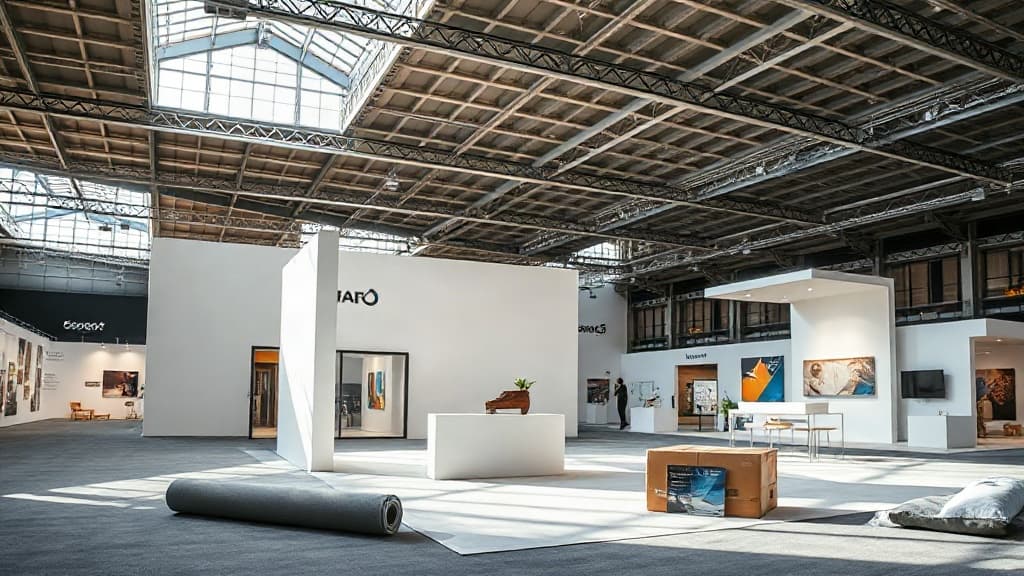
A booth at a European trade fair, two flights and a week of hotels add up quickly for a small manufacturer. Most US states have money to pay part of that bill. It comes from the State Trade Expansion Program (STEP), a federal grant the US Small Business Administration (SBA) gives to states, which then pass it on to small exporters as reimbursements.
Below: how STEP works, what it pays for, and what nine large exporting states offer, each checked against the state agency's own page.
Putting it simply: you do not apply to the SBA. You apply to your state trade office, before you spend, for a specific activity such as exhibiting at a European trade show. If approved, you pay the costs yourself and claim back a share, typically 50% to 90%, up to a cap that in most of the states below is $10,000 to $20,000 a year. The product usually has to be at least 51% US content.
What STEP is
STEP is written into the Small Business Act at 15 U.S.C. § 649(l). The statute tells the SBA to "make grants to States to carry out programs that assist eligible small business concerns" in nine kinds of activity:
- participation in foreign trade missions;
- a subscription to services provided by the Department of Commerce;
- website fees;
- the design of marketing media;
- a trade show exhibition;
- training workshops;
- a reverse trade mission;
- consultancy services (after consultation with Commerce to avoid duplication);
- any other initiative the SBA's Associate Administrator approves.
The SBA's program page describes the same list in plainer words, adds "translation fees", and says the grants "are specifically for established U.S. small businesses". The "Department of Commerce services" line covers the US Commercial Service's paid services, such as the International Partner Search and Gold Key, which cost $2,500 and $3,250 since July 22, 2026 (see what $2,500 buys at the Commercial Service).
The money moves in two steps. The SBA awards each state a grant on a competitive basis, and a state may apply only once per fiscal year. For FY2026 the SBA posted the call (SB-OIT-STEP-2026-01) on July 10, 2026, with awards from $100,000 to $900,000 and about 55 expected awards. The Congressional Research Service puts the anticipated FY2026 total at $20 million. The law also caps what the ten states with the highest share of eligible small businesses can receive at 40% of the year's appropriation; for FY2026 the CRS names them as California, Florida, Georgia, Illinois, Michigan, New Jersey, New York, Ohio, Pennsylvania and Texas.
One detail is often misread. The statute's "federal share" of at most 65% or 75% is the SBA's share of the state's program budget, with the state adding the rest. It is not the share of your costs you get back. Your reimbursement rate is set by your state.
Who qualifies
The statute defines an "eligible small business concern" as one that:
- "is organized or incorporated in the United States";
- "is operating in the United States";
- meets the SBA's industry-based size standard or the alternate size standard;
- "has been in business for not less than 1 year";
- "has access to sufficient resources to bear the costs associated with trade, including the costs of packing, shipping, freight forwarding, and customs brokers".
The law sets no rule on US content, but the states do. California, Texas and Ohio all ask for at least 51% US content, and Illinois asks for 51% US plus 25% Illinois content. Texas explains why: to qualify for the Commercial Service's fee-based services, "a company must have at least 51% U.S. content on its products or services." Texas also asks applicants to "have in effect a strategic plan for exporting; and demonstrate export readiness", and to register in SAM.gov.
Two practical points apply almost everywhere. First, approval comes before the activity: Ohio's handbook states that "activities must be approved before the activities are conducted," and Pennsylvania requires applications "prior to the activity for which funding is sought." Second, you pay first and claim later. California warns that reimbursement "may take up to 60 days after submitting proper documentation."
Nine states compared
The SBA's directory lists the state agency behind each STEP grant and what it received in FY2024 (for Texas and Wisconsin the directory shows only an FY2023 amount). Here is what the agencies themselves publish now. Caps and rates change every program year, so treat this as a starting point and confirm with the office.
| State | Agency and local name | What you get back | SBA award (FY2024; FY2023 where marked) |
|---|---|---|---|
| California | GO-Biz, California STEP (Export Vouchers, STEP events) | Up to 75% of pre-approved costs, capped at $10,000 per federal fiscal year; subsidized fees for up to 2 STEP events a year | $900,000 |
| Texas | Texas Department of Agriculture, STEP | 90% of paid eligible expenses with a 10% cash match; up to $20,000 (Market Expansion) or $10,000 (New to Export) | $500,000 (FY2023) |
| Ohio | Department of Development, IMAGE | 50% reimbursement, up to $10,000 per grant year starting Oct. 1 | $300,000 |
| Michigan | MEDC, MI-STEP | 75% reimbursement, up to $15,000 a year | $900,000 |
| Illinois | DCEO, ISTEP | Trade missions 25–75% of travel up to $5,000 (group) or $10,000 (individual); compliance, website localization and EXIM insurance 50% up to $10,000 | $400,000 |
| Pennsylvania | DCED, Global Access Program (GAP) | Up to 75% of eligible expenses, up to $10,000 per award year | $825,000 |
| North Carolina | EDPNC, STEP | Up to $12,000 per company, including up to $8,000 for booth costs | $900,000 |
| Wisconsin | WEDC, International Market Access Grant | Up to $10,000 per grant ($30,000 for ExporTech graduates), 30% company match; lifetime limit of three grants (six for ExporTech graduates) | $350,000 (FY2023) |
| New York | Empire State Development, Global NY STEP | Not confirmed (see below) | $900,000 |
Some notes from the source documents:
- California checks eligibility with a questionnaire: registered and in good standing in California, operating for at least one full year, at least 51% US content, and small under 13 CFR Part 121.
- Texas closed its 2026 round on September 10, 2026. Approved projects run from September 1, 2026 to June 30, 2027. Texas also requires the product to be made or value-added in Texas, and flights must follow the Fly America rules (US carriers or Open Skies partners, economy class). Its list of eligible costs includes the cost of a CE mark, which matters for most products entering the EU (compliance checklist). Airfare is economy only, on US carriers under the Fly America Act, for up to two employees.
- Ohio's published handbook is dated September 2023. It funds international trade shows, Commercial Service programs and compliance testing; individual market visits only alongside a completed program such as a Gold Key.
- Michigan accepts applications from October 1 to September 15. In August 2026 MEDC announced that the eligible uses had expanded from FY25 to include marketing-media translation, compliance testing and international certification, and sample shipping.
- Illinois requires fewer than 500 employees, at least one year in operation and gross annual revenue of at least $250,000.
- Pennsylvania's GAP lists compliance testing, including CE, among eligible costs. You apply through a Regional Export Network partner.
- North Carolina's current round, STEP 13, runs from June 30, 2026 to September 29, 2027. The $12,000 cap includes up to $8,000 for booth costs and up to $3,000 for travel when you co-exhibit in the EDPNC booth.
- Wisconsin's FY27 packet does not say whether this grant is STEP-funded. It sets its own rules: at least 35% Wisconsin cost inputs, gross revenue under $50 million, and no reimbursement for flights and hotels, which count only toward the 30% match.
- New York: the agency's site blocked our automated checks, so as of October 21, 2026 we could not confirm the current Global NY STEP rates from its own page. Call or email the office listed on the SBA directory.
- Minnesota is not in the SBA's FY2024 table of awardees. As of October 21, 2026 we could not confirm whether it runs a STEP program this year.
For other states, the SBA directory lists a project director and phone number.
The calendar is set by the state, not the trade show
There is no single national deadline. Each state works to its own program year, usually tied to the SBA grant period. That is why the windows above differ: Michigan from October 1 to September 15, Ohio from October 1, Texas one round closing in September, North Carolina from June 30. California runs Export Voucher rounds with their own deadlines.
Plan backward from the event: a spring trade fair in Europe needs a state application months earlier, before you pay for the stand. Ask the office when the current round closes and whether money is left in it.
Pick the country before you book the trip
A STEP grant cuts the cost of a trip, but it cannot tell you where to go. States cap what one company can receive, so a wasted trip also uses up your allowance. The order that saves money is: choose the country, find out who already sells your category there, and only then book the show or the sales trip.
For the country choice, start with Germany, the Netherlands, France or Poland: which EU market first. Germany, for example, is best approached through its trade fairs, which suits STEP's trade-show funding. The choice of route is in distributor vs. subsidiary vs. direct online.
For the shortlist, public contract award notices are one way to see which companies already sell your category in a country. Cresques builds that list from notices published on TED since November 2023: you create a market (a country plus your CPV categories) and see the companies that won contracts, each award traceable to its notice. The Free plan covers one market map; prices are on /pricing. Cresques does not help anyone bid for public contracts, and the notices show only public-sector sales.
What this means for a US manufacturer
- Call your state trade office first. STEP money reaches you only through the state, and only for activities approved in advance.
- Expect to pay up front. You are reimbursed after the activity, against receipts, often weeks later.
- Check your US content. At least 51% is the common bar, and some states add a state-content rule.
- Use it on the expensive steps: a booth, a Gold Key, a translated website. Keep itemized invoices.
- Spend it on the right country. Build the shortlist of distributors before you book, so the trip ends in meetings, not just booth traffic. Our guide for US manufacturers and the distributor playbook set out the steps.
Grant rules change every program year. Confirm the current terms with your state office before you commit any spending, and ask your tax adviser how a reimbursement grant is treated in your accounts.