Fire safety and security equipment
How public bodies buy fire detection, extinguishers, intrusion alarms, access control and CCTV, why certified installers decide, and the rules they check.
Updated 16 October 2026
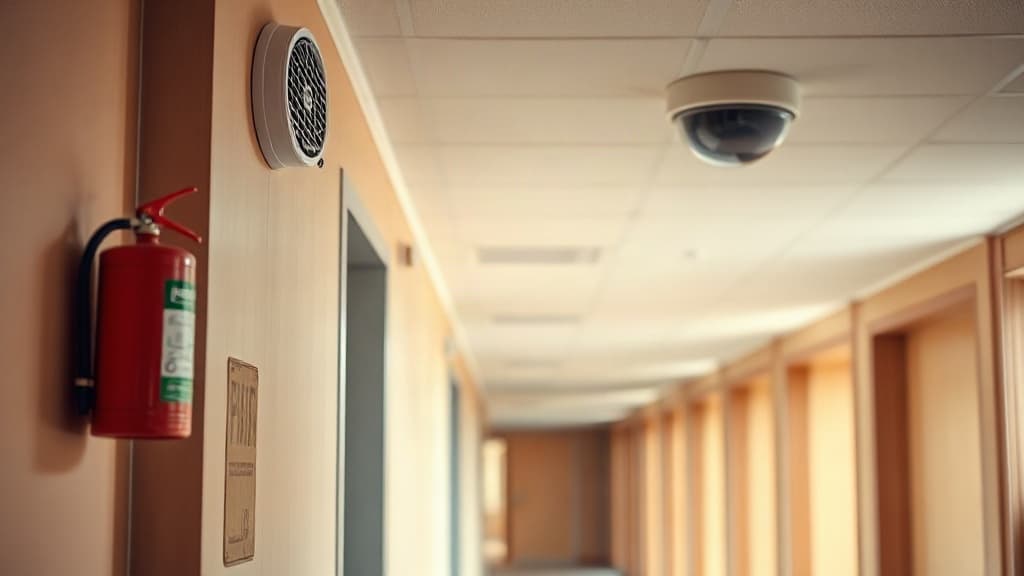
What public buyers purchase
Fire protection and security are needed across the whole public estate, so the buyers are many: hospitals, schools and universities, offices, museums, courts, prisons, municipalities and transport operators. They buy fire detection and alarm systems, extinguishers and hose reels, intrusion alarms, access control and video surveillance, and pay for the servicing that keeps them working.
In the Common Procurement Vocabulary the equipment sits under 35100000 Emergency and security equipment, with 35111000 Firefighting equipment and 35111300 Fire extinguishers. Alarms are 31625000 Burglar and fire alarms, with 31625100 Fire-detection systems, 31625200 Fire-alarm systems and 31625300 Burglar-alarm systems. Security equipment is 35121000, cameras 35125300 Security cameras or 32323500 Video-surveillance system, and access control 42961100 Access control system.
Much of the spending is not a product purchase at all. Systems arrive inside works contracts — 45312100 Fire-alarm system installation work, 45312200 Burglar-alarm system installation work, 45343000 Fire-prevention installation works — and stay under maintenance contracts such as 50413200 Repair and maintenance services of firefighting equipment and 50610000 Repair and maintenance services of security equipment.
How distribution works
This is an installer-led trade. Fire and security companies design a system, buy the detectors, panels, cameras and readers from specialist distributors or directly from manufacturers, install and commission it, and often hold the maintenance contract afterwards. Extinguishers move through service companies that supply, inspect and refill them on site. Because the installer will service what it installs, spare parts and long-term support weigh heavily in its choice of brand.
Award notices make the chain visible. Supply awards name the distributors already selling equipment to public buyers; installation and maintenance awards name the installers active in each region, which are the customers a distributor will expect you to help it win. Both appear on TED with the winner and the CPV code. Cresques uses that evidence to show who sells a category where; it does not help you bid.
What distributors expect
Fire and security products protect lives and insured property, so documents decide the first conversation:
- For fire detection and alarm components — detectors, control and indicating equipment, sounders, manual call points, power supplies — a declaration of performance and CE marking under the Construction Products Regulation, against the harmonised parts of EN 54, Fire detection and fire alarm systems; smoke alarm devices follow EN 14604. The attestation procedure set for these products in Decision 96/577/EC (system 1) involves a notified product certification body, so expect to show its certificate of constancy of performance. The new Construction Products Regulation (EU) 2024/3110 has applied since 8 January 2026, but standards listed under Regulation (EU) No 305/2011 that were in force on that date remain valid until the Commission withdraws them.
- For portable extinguishers, conformity under the Pressure Equipment Directive 2014/68/EU, which places them at least in category III, so a notified body takes part. The EN 3 series covers their characteristics and performance (EN 3-7) and their construction and pressure resistance (EN 3-8). Servicing is a separate question: as of October 2026 we could not confirm an EU-wide servicing rule, so ask the distributor which national standard its technicians work to.
- For wireless detectors, keypads and cameras, conformity with the Radio Equipment Directive 2014/53/EU. Since 1 August 2025, internet-connected radio equipment must also meet the cybersecurity requirements activated by Delegated Regulation (EU) 2022/30.
- A plan for the Cyber Resilience Act, Regulation (EU) 2024/2847. It applies in full from 11 December 2027, and manufacturers' obligations to report actively exploited vulnerabilities and severe incidents have applied since 11 September 2026. Its Annex III lists access control readers, including biometric readers, as important products, along with smart home products with security functions such as security cameras and alarm systems. A distributor stocking for a multi-year contract will ask how long you support each product with security updates.
- Performance against the voluntary European standards buyers can specify: EN 50131-1 for intrusion and hold-up systems, EN 62676-1-1 for video surveillance systems and EN 60839-11-1 for electronic access control.
- National approvals where they matter. Voluntary schemes with roots in the insurance industry carry weight in some markets: VdS Schadenverhütung in Germany, CNPP's product marks in France (NF, such as NF SSI for fire detection, and A2P for intrusion products; APSAD certifies installers and maintainers, not products), and LPCB in the UK, which lists approved products on RedBookLive. As of October 2026 we could not confirm when a public buyer may require them in a tender, so ask the distributor before you budget for testing.
- For video, features that help the buyer meet the GDPR. A public body running CCTV is the controller of that personal data, and the EDPB's Guidelines 3/2019 on processing of personal data through video devices set out what it must consider; equipment that makes it easy to limit what is recorded, protect the footage and delete it on schedule is easier to sell.
Markets to start with
France. A large public estate; ask early whether a distributor expects CNPP certification for your products. B2B e-mail to a company's generic address (info@, contact@) needs no consent under CNIL guidance, so a first approach by e-mail is workable; a named professional address needs more (see France).
Germany. A large market; ask early whether a distributor expects VdS approval for your products. E-mail advertising without prior express consent is unlawful, so plan on letters, trade fairs and introductions, and expect a longer sales cycle.
UK and Ireland. The UK publishes above-threshold awards on Find a Tender rather than TED; ask whether a distributor expects LPCB approval. Unsolicited e-mail to companies is allowed if you identify yourself and give an opt-out. Ireland stays inside the EU regime, so its awards appear on TED, and marketing e-mail to a company is permitted on similar conditions.
Benelux. All three countries publish on TED, with different e-mail rules. In Belgium, e-mail without consent is lawful only to a company's impersonal address, such as info@, for an offer aimed at businesses. The Netherlands requires prior consent for unsolicited commercial e-mail, businesses included. In Luxembourg, use a generic company address or a letter.
The industry in numbers
Public supply contracts across 30 European countries, from TED award notices (2023-11 – 2026-11)
- Contracts awarded
- 26.5K
- Awarded value
- €14B
- 68% of awards with a published value
- Won from abroad
- 4.8%
Table view
| Emergency and security equipment | 10,010 |
| Miscellaneous general and special-purpose machinery | 9,073 |
| Electrical equipment and apparatus | 7,425 |
Questions
- Which CPV codes cover fire safety and security equipment in public tenders?
- The main codes are 35100000 Emergency and security equipment, 35111000 Firefighting equipment, 35111300 Fire extinguishers, 31625000 Burglar and fire alarms with 31625100 Fire-detection systems, 35121000 Security equipment, 35125300 Security cameras and 42961100 Access control system. Installation and maintenance are bought under codes such as 45312100 Fire-alarm system installation work and 50413200 Repair and maintenance services of firefighting equipment.
- Do fire detectors and alarm panels need third-party certification in the EU?
- Fire detection and alarm components such as detectors, control and indicating equipment and manual call points are construction products covered by harmonised parts of EN 54. The attestation procedure set for them (system 1) involves a notified product certification body as well as the manufacturer's factory production control, so a distributor will ask for the declaration of performance and the certificate.
- Which rules apply to portable fire extinguishers?
- Portable extinguishers fall under the Pressure Equipment Directive 2014/68/EU, which classifies them at least in category III, so a notified body takes part in conformity assessment. The EN 3 series sets characteristics, performance and construction requirements. Servicing requirements should be checked country by country.
- What do connected cameras and access-control readers need from 2025 onwards?
- Internet-connected radio equipment has had to meet cybersecurity requirements under Delegated Regulation (EU) 2022/30 since 1 August 2025. The Cyber Resilience Act applies in full from 11 December 2027, with manufacturers' reporting obligations from 11 September 2026; it lists access control readers, including biometric readers, as important products.