IT hardware and peripherals
How public bodies buy computers, monitors, printers and network kit through frameworks, the resellers that win them, and the EU rules distributors check.
Updated 16 October 2026
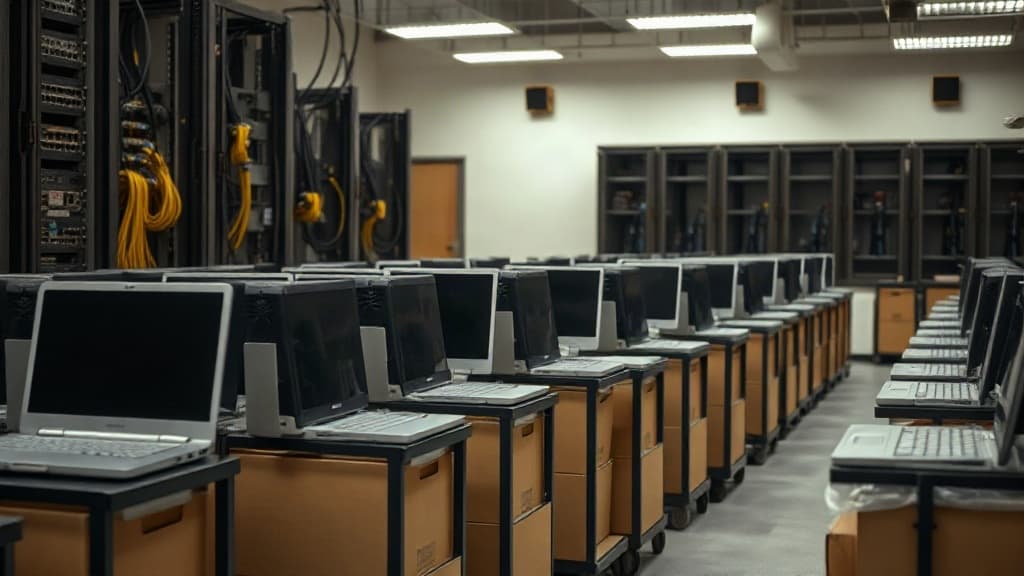
What public buyers purchase
Every ministry, municipality, school, university and hospital runs on IT hardware, and most of it is replaced on a cycle: notebooks and desktops, monitors, printers and multifunction devices, servers and storage, and the switches, routers and wireless access points that connect them. In the CPV the family is 30200000 Computer equipment and supplies, with 30213000 Personal computers, 30213100 Portable computers, 30231300 Display screens, 30232000 Peripheral equipment and 30232110 Laser printers. Network gear sits under 32420000 Network equipment and servers under 48820000 Servers. Maintenance is usually coded separately, under 50312000 Maintenance and repair of computer equipment.
Public buyers often call off standard hardware from frameworks and electronic catalogues rather than run a tender for each need. In the UK, the Government Commercial Agency (formerly Crown Commercial Service) runs Technology Products & Associated Services 2 (RM6098), open to all UK public sector organisations until 9 October 2027, with lots that include hardware, education technology, health and social care technology, sustainability and circular IT, and a technology catalogue. In France, UGAP, the national central purchasing body, has an IT and telephony range covering office computing, telecoms, networks and servers. In Germany, the Kaufhaus des Bundes is the federal administration's electronic purchasing platform: four central purchasing bodies bundle demand and conclude framework agreements for standard products, which registered federal bodies then order online.
How distribution works
IT hardware moves through two tiers. Broadline and specialist distributors buy from manufacturers, hold stock, extend credit and run the logistics. Resellers, system integrators and managed-service providers buy from them and sell to the end customer, adding configuration, imaging, deployment, support and take-back. Public frameworks are usually won by this second tier, because buyers want one supplier that can deliver, install and support many brands across many sites. A new manufacturer typically needs a distributor before resellers will list it.
The evidence of who sells where sits in the award notices. A TED notice names the winning reseller or integrator and carries the CPV code, so the partner that won a region's school notebook lot, or the integrator behind a hospital network refresh, is identifiable from the public record. Those resellers are the customers a distributor will expect your brand to help it win. Cresques turns a country and a set of categories into that list of winners; it does not help you bid.
What distributors expect
An IT distributor carries your product's compliance into every reseller's tender, so expect these questions first:
- RoHS and WEEE. Directive 2011/65/EU restricts hazardous substances in electrical and electronic equipment, including cables and spare parts. Under the WEEE Directive 2012/19/EU, a company established in a Member State that places equipment from a third country on that market counts as the producer there, so agree early who registers and finances collection in each country.
- Ecodesign and energy labelling. Monitors fall under ecodesign Regulation (EU) 2019/2021 and carry an energy label under Delegated Regulation (EU) 2019/2013, both applying since 1 March 2021, with each model entered in the EU product database (EPREL). The ecodesign rules include keeping certain spare parts available for at least seven years after the last unit of a model is placed on the market. Desktops, notebooks and workstations are covered by ecodesign Regulation (EU) No 617/2013, and servers and data storage products by ecodesign Regulation (EU) 2019/424.
- Radio and charging rules. Notebooks with Wi-Fi or Bluetooth are radio equipment under Directive 2014/53/EU. Since 1 August 2025, internet-connected radio equipment must meet the cybersecurity requirements set by Delegated Regulation (EU) 2022/30, and since 28 April 2026 laptops that can be charged by cable must have a USB Type-C charging port under the common-charger Directive (EU) 2022/2380.
- A plan for the Cyber Resilience Act. Regulation (EU) 2024/2847 applies to products with digital elements from 11 December 2027, but the manufacturer's duty to report actively exploited vulnerabilities and severe security incidents applies from 11 September 2026. Distributors will ask how you handle vulnerabilities and how long you will provide security updates.
- Green procurement evidence. The EU GPP criteria for computers, monitors, tablets and smartphones (2021) ask for a manufacturer's warranty, an extended service agreement and spare parts for at least two years in the core criteria and three in the comprehensive set, design for repair of listed components, secure data deletion, battery endurance tests for portables, a USB Type-C port and limits on halogens in plastic parts. The core criteria accept monitors in energy classes A to D. Products holding a relevant ISO 14024 type I ecolabel are deemed to comply with many criteria, so state which labels you hold.
- Channel terms: distributor margin, price protection, stock rotation, a partner programme for resellers, an RMA process with local-language support, and a product roadmap that lets a framework lot be supplied for its full term.
Markets to start with
France. UGAP is a national route for public buyers once a product is referenced, and the resellers active on public contracts are visible in award notices. B2B e-mail to a company's generic address (info@, contact@) needs no consent under CNIL guidance, so a first approach by e-mail is workable; a named professional address needs more (see France).
Germany. Federal bodies order standard products through the Kaufhaus des Bundes, while the Länder and municipalities run their own procurement. E-mail advertising without prior express consent is unlawful, so plan on letters, trade fairs and introductions.
UK and Ireland. Public bodies can buy through RM6098, and the UK publishes above-threshold awards on Find a Tender rather than TED. Unsolicited e-mail to companies is allowed if you identify yourself and give an opt-out. Ireland stays inside the EU regime, so its awards appear on TED and the EU product rules above apply there.
Netherlands. Unsolicited commercial e-mail requires prior consent, including for businesses, unless the company has published an address specifically for receiving such offers, so the first contact is by post, at a fair or through an introduction.
Nordics and Baltics. Sweden, Finland, Denmark and the Baltic states publish on TED as EU members, and Norway does so through the EEA. Sweden, Finland, Estonia, Latvia and Lithuania allow e-mail to companies if every message offers an opt-out; Norway allows it to a company's general address but not to an employee's own; Denmark requires prior consent, including for businesses.
The industry in numbers
Public supply contracts across 30 European countries, from TED award notices (2023-11 – 2026-11)
- Contracts awarded
- 61.4K
- Awarded value
- €38B
- 79% of awards with a published value
- Won from abroad
- 1.2%
- Networks9,564
Table view
| Computer equipment and supplies | 43,185 |
| Networks | 9,564 |
| Information systems and servers | 8,662 |
Questions
- Which CPV codes cover computers, monitors and printers in public tenders?
- The family is 30200000 Computer equipment and supplies, with 30213000 Personal computers, 30213100 Portable computers, 30231300 Display screens, 30232000 Peripheral equipment and 30232110 Laser printers. Network gear is coded 32420000 Network equipment and servers 48820000 Servers.
- Who wins public IT hardware contracts, manufacturers or resellers?
- Usually resellers, system integrators and managed-service providers, which buy from distributors and deliver, configure, deploy and support many brands across many sites. Manufacturers reach public buyers mainly through these partners, so the resellers named in award notices are the customers a distributor will expect your brand to help it win.
- When does the Cyber Resilience Act apply to IT hardware?
- Regulation (EU) 2024/2847 applies to products with digital elements from 11 December 2027. The manufacturer's duty to report actively exploited vulnerabilities and severe security incidents, in Article 14, applies earlier, from 11 September 2026, and the rules on notifying conformity assessment bodies from 11 June 2026.
- What do EU green procurement criteria ask of computers and monitors?
- The 2021 EU GPP criteria for computers, monitors, tablets and smartphones cover warranty, service and spare parts for at least two years in the core set (three in the comprehensive set), design for repair, secure data deletion, battery endurance for portables, a USB Type-C port, energy performance, hazardous substances and end-of-life management.