Enterprise Europe Network, export agencies and trade fairs: the free and the human routes to a distributor
What the EEN database, national export agencies, chambers abroad and the leading trade fairs offer a manufacturer — strengths, limits, timing and sequence.

Marta Zielińska · Market research
Updated 29 October 2026 · 7 min read
Before any paid tool, a manufacturer has three routes that cost little in money and a great deal in patience: a public partnering database, its own country's export agencies and chambers, and the trade fairs where a sector meets. Each gives evidence software cannot — a human has looked — and each runs on a clock you do not control.
Putting it simply: The Enterprise Europe Network database is free, EU-wide and self-declared: good for finding companies that have said they want a supplier, thin in many niches. Export agencies and chambers work for their own country's exporters; a vetted introduction is strong evidence but takes weeks to months. Trade fairs let you see a distributor's range with your own eyes, once every one or two years, in one city. Use all three around a shortlist you already have, rather than as the way to build one.
Disclosure: Cresques is our own product. We compare on criteria you can check yourself and link to each source.
The Enterprise Europe Network partnering database
The Enterprise Europe Network, run under the European Commission, describes its partnering database as Europe's largest online database of business opportunities. It holds five kinds of profile: business offers, business requests, research and development requests, technology offers and technology requests. For a manufacturer the relevant entries are business requests — a company in your target country stating that it is looking for products to distribute, usually under the partnership type "commercial agreement" — and the offers from distributors describing what they already carry.
In practice you search the database, express your interest, and the Network's local member organisations handle the introduction. Searching is free and open.
Strengths: EU-wide and beyond, free, and introductions go through a local Network member. Limits: the profile is still the company's own description, live requests in a specific niche — contract seating in Portugal, say — may be a handful or none, a profile can sit for months, and response times depend on the local member on each side.
Export agencies and chambers: whose side are they on?
One caveat saves wasted e-mails: a national agency exists to help its own country's companies export and to attract investors into its country. For a Polish manufacturer entering France, the agency that works for you is PAIH; Business France mostly helps French companies abroad or companies investing in France. Chambers abroad are the exception: the German AHK network says it connects companies "with the right local points of contact" for market entry.
| Organisation | Country | Own description (October 2026) | Relevant to a manufacturer |
|---|---|---|---|
| Business France / Team France Export | France | "The national agency serving the international development of the French economy"; about 1,400 staff in France and 53 other countries; Team France Export combines Business France, Bpifrance and the chambers of commerce | Helps French exporters; for a foreign manufacturer, mainly a route for investing in France |
| Germany Trade & Invest (GTAI) | Germany | "The economic development agency of the Federal Republic of Germany"; 60 international locations; analysts reporting on 150 countries | Market reports and investor support; not a distributor-matching service for foreign exporters |
| AHK (German Chambers of Commerce Abroad) | Germany, worldwide | "Across 150 locations in over 90 countries"; supports "entry and expansion into new markets"; independent bilateral chambers coordinated by the DIHK and subsidised by the Federal Ministry for Economic Affairs and Energy | Partner searches and market-entry services (ask about fees); works in both directions |
| PAIH (Polish Investment and Trade Agency) | Poland | "The first point of contact for exporters and investors"; part of the PFR Group; a network of Foreign and Regional Trade Offices | Works for Polish exporters through its offices abroad |
| Enterprise Ireland | Ireland | "The Irish government's enterprise development agency"; 40 international offices | Works for Irish exporters, including market research and introductions |
A good agency partner search gives you a shortlist that a person in the target country has looked at and often phoned — strong evidence of fit and interest. It costs time (a brief, a wait, a follow-up round) and sometimes a fee for the chamber's work. The shortlist is only as good as the brief: name the CPV categories your product falls under and the buyers you want to reach.
Trade fairs: the sector in one hall
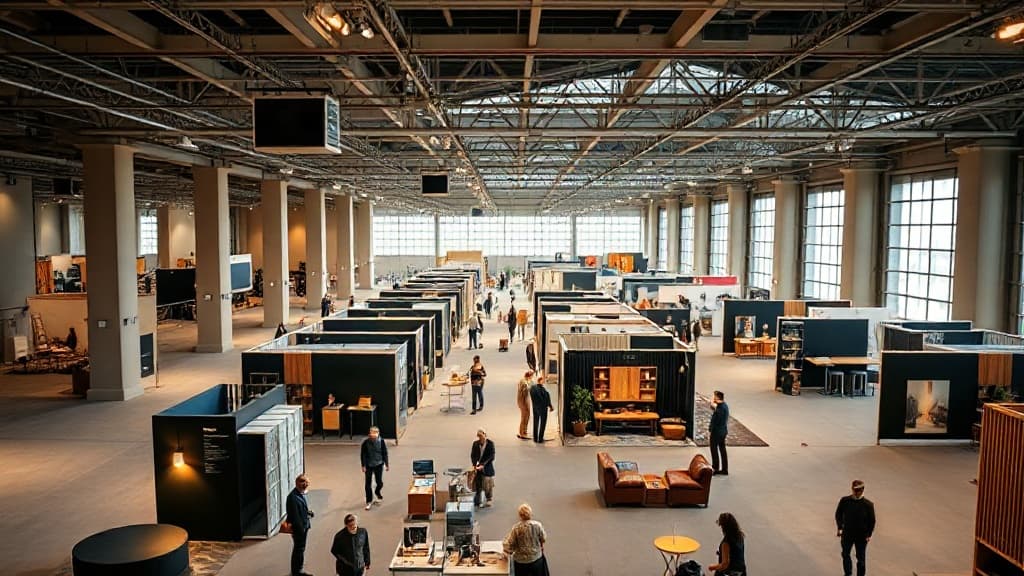
A fair is the only method where you see a distributor's actual range, meet the people and judge the stand in ten minutes. The leading fairs for the sectors Cresques covers first are concentrated in Germany.
| Fair | Sector | Organiser | City | Cadence | Next edition (organiser's site) | Scale (organiser's figures) |
|---|---|---|---|---|---|---|
| ORGATEC | Office and contract furniture, workplace environments | Koelnmesse | Cologne | Every two years | 27–30 October 2026 | Not stated on the landing page |
| BAU | Architecture, materials, systems (building) | Messe München | Munich | Every two years | 11–15 January 2027 | "World's Leading Trade Fair for Architecture, Materials, Systems" |
| A+A | Safety, security and health at work (PPE, workwear) | Messe Düsseldorf | Düsseldorf | Every two years | 19–22 October 2027 | 2025: 2,335 exhibitors from 69 countries; 66,636 visitors from 145 countries |
| MEDICA | Medical industry | Messe Düsseldorf | Düsseldorf | Every year, November | MEDICA 2026 | 2025: 4,821 MEDICA exhibitors (5,584 with COMPAMED, from 70 countries); 78,000 visitors from 160 countries |
Strengths: direct evidence, relationships, a whole sector in a few days, competitors' distributors visible on their stands. Limits: the calendar (a biennial fair can mean an eighteen-month wait), the geography (a French regional distributor may not travel to Cologne), the cost (the most expensive line in a market-entry budget) and the sample — you meet whoever exhibits or walks past, not the companies that quietly win the public contracts in your category. A fair is at its best as the last step: arrive with the distributors you want to meet, their stand numbers and what you know they already sell.
Consultants and commercial agents
Two human routes sit outside the tables because their value cannot be compared on a website. A market-entry consultant sells judgement and a network; the result depends on the person, the brief and how many clients compete for the same introductions. A commercial agent — a self-employed intermediary paid by commission to negotiate sales in a territory — is a route to market in itself rather than a way to find a distributor, and the relationship carries obligations on termination that deserve legal advice before signing. Ask either the question you would ask a tool: which of these companies has demonstrably sold my category, and how do you know?
Combining the free routes with evidence
The three routes answer different questions. The EEN database tells you who says they want a supplier. An agency tells you who a professional thinks fits. A fair shows you what they actually carry. None of them tells you who has already sold your category to a real customer — and that is the question a public document answers. Every working day TED, the Supplement to the Official Journal of the EU, publishes more than 3,000 procurement notices; when a public buyer concludes a contract above the EU thresholds it must publish an award notice naming the winner and the CPV category (Directive 2014/24/EU, Article 50).
A workable order: build the shortlist from award notices, confirm each company in the business register, check the EEN database for any of them asking for suppliers, brief your agency with the names, and book the fair to meet them. Cresques does the first step — you create a market as a country plus CPV categories, every company is tied to a notice you can open, and the lawful first-contact channel is shown per country; company profiles with an AI-researched role and first messages drafted in the local language are live, and e-mail alerts on new awards come with paid plans. The human routes do the rest, better for having a list to start from.
What this means for a manufacturer
- The EEN database is free and worth a search in every market; expect self-declared profiles and thin niches.
- Your own country's agency works for you; the target country's agency mostly works for its own exporters. Chambers abroad work both ways, usually for a fee.
- A vetted introduction is strong evidence but slow; brief the adviser with CPV categories and target buyers.
- Fairs give the best evidence per meeting and the worst evidence per euro; go with a list.
- Start from the public record of who has sold your category, then let people do what people do best.