Sports and playground equipment
How municipalities, schools and leisure centres buy playground, fitness and sports equipment, who installs it, and the safety files a dealer checks first.
Updated 16 October 2026
What public buyers purchase
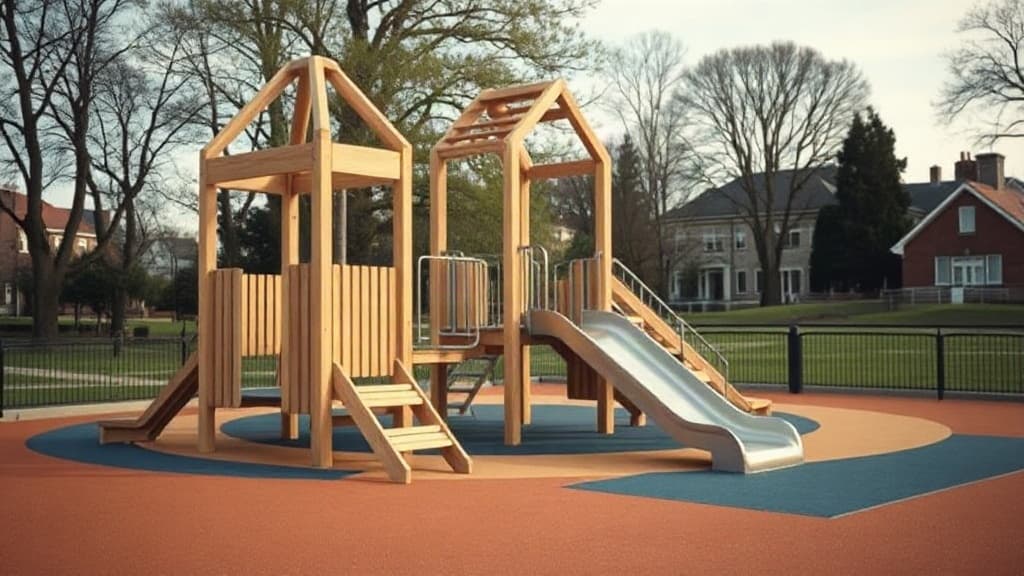
Much of the public demand comes from local government. Towns and cities build and renew play areas in parks and housing estates; schools equip sports halls and playgrounds; local authorities and their operating companies run swimming pools, gyms and outdoor sports grounds. A purchase can be a set of goals for one school or a complete play area with equipment, surfacing, fencing and benches, and some parks add outdoor fitness stations for adults.
In the Common Procurement Vocabulary the category sits under 37400000 Sports goods and equipment, with 37410000 Outdoor sports equipment, 37420000 Gymnasium equipment, 37440000 Fitness equipments and 37450000 Field and court sports equipment. Playground equipment has its own branch, 37535200 Playground equipment, with sub-codes such as 37535210 Playground swings, 37535220 Playground climbing apparatus and 37535240 Playground slides. Some buyers use 43325000 Park and playground equipment instead.
Supply contracts are only part of the picture. Much equipment arrives inside works contracts — 45212200 Construction work for sports facilities, 45112723 Landscaping work for playgrounds or 45236210 Flatwork for children's play area — where the award goes to the contractor that builds the site. Upkeep follows under 50870000 Repair and maintenance services of playground equipment, and gym equipment can come with 51121000 Installation services of fitness equipment.
How distribution works
Outdoor play and fitness is a design-and-install trade. The company that wins a play-area contract usually designs the layout, supplies equipment from its own range or from the manufacturers it represents, lays the surfacing, installs the site and often keeps the maintenance contract afterwards. Indoor sports equipment moves through specialist sports dealers and school suppliers, and commercial fitness equipment through dealers with their own service technicians.
For a foreign manufacturer, those companies are the route in. Award notices on TED name the winner and carry the CPV code, so the installer that keeps winning play areas for municipalities in one region, or the dealer that equips school sports halls, is visible from the public record. Works awards point to the landscaping and sports-construction contractors who decide which brands go into a scheme. Cresques uses that evidence to show who sells a category where; it does not help you bid.
What distributors expect
A distributor that installs your equipment in a public park takes on your safety risk, so the documents come first:
- Compliance with the General Product Safety Regulation (EU) 2023/988, which has applied since 13 December 2024. Its definition of a product includes items made available "in the context of providing a service" that consumers are likely to use, which brings equipment used by the public in parks and leisure centres within its reach. The manufacturer must carry out an internal risk analysis, keep the technical documentation for 10 years, mark products with a type, batch or serial number, and give its name, postal and electronic address. A product may not be placed on the EU market unless an economic operator established in the Union is responsible for it.
- Test evidence against the EN 1176 series, Playground equipment and surfacing. Part 1 sets general safety requirements and test methods for permanently installed public playground equipment; later parts add requirements for specific types of equipment. Surfacing under the equipment is tested with EN 1177, Impact attenuating playground surfacing — Methods of test for determination of impact attenuation.
- For outdoor fitness, EN 16630, Permanently installed outdoor fitness equipment. It covers manufacture, installation, inspection and maintenance of freely accessible equipment for youths and adults (users taller than 1 400 mm) and is separate from children's playground equipment.
- For gyms and sports halls, EN ISO 20957-1, Stationary training equipment — Part 1. It classes equipment for the training areas of sports associations, schools, hotels, clubs and studios as S or I, and domestic equipment as H, so a distributor serving public facilities will ask which class each product carries.
- Installation, inspection and maintenance documentation. EN 1176-7 gives playground operators guidance on installation, inspection, maintenance and operation, so the distributor needs installation instructions, inspection checklists and a spare-parts list in the local language, with parts available for the life of the equipment.
- Planning assets: layout drawings, 3D models, free-space and foundation details that let the distributor's designers place your equipment in a tender drawing.
- A commercial package: dealer margin, territory, who installs and inspects, and warranty terms the installer can pass through to the buyer.
A reference site in your home market that a distributor can visit, with its inspection records, often does more than a catalogue.
Markets to start with
France. Municipalities and inter-municipal bodies buy play areas and sports equipment locally, so award notices show which installers work in which region. B2B e-mail to a company's generic address (info@, contact@) needs no consent under CNIL guidance, so a first approach by e-mail is workable; a named professional address needs more (see France).
Germany. Municipalities, school authorities and sports facility operators buy locally, through a network of specialist planners and installers. E-mail advertising without prior express consent is unlawful, so plan on letters, trade fairs and introductions, and expect a longer sales cycle.
UK and Ireland. The UK publishes above-threshold awards on Find a Tender rather than TED. Unsolicited e-mail to companies is allowed if you identify yourself and give an opt-out. Ireland stays inside the EU regime, so its awards appear on TED, and marketing e-mail to a company is permitted on similar conditions.
Nordics. Sweden and Finland publish on TED as EU members, and Norway does so through the EEA. All three allow marketing e-mail to companies if each message offers a way to opt out; in Norway that means a company address such as post@, not an employee's own work address. Denmark, also on TED, requires prior consent for e-mail marketing, businesses included, so open there with a letter or an introduction.
The industry in numbers
Public supply contracts across 30 European countries, from TED award notices (2023-11 – 2026-11)
- Contracts awarded
- 7.6K
- Awarded value
- €2.2B
- 63% of awards with a published value
- Won from abroad
- 3%
Table view
| Sports goods and equipment | 3,318 |
| Construction machinery and equipment | 2,156 |
| Games and toys; fairground amusements | 2,115 |
Questions
- Which CPV codes cover playground and sports equipment in public tenders?
- Sports goods sit under CPV 37400000, with 37410000 Outdoor sports equipment, 37420000 Gymnasium equipment, 37440000 Fitness equipments and 37450000 Field and court sports equipment. Playground equipment is 37535200, with sub-codes for swings, slides and climbing apparatus; some buyers use 43325000 Park and playground equipment. Many play areas are bought inside works contracts such as 45212200 or 45236210.
- Which European standards apply to playground and outdoor fitness equipment?
- Playground equipment is tested to the EN 1176 series, Playground equipment and surfacing; impact-attenuating surfacing is tested with EN 1177; permanently installed outdoor fitness equipment for youths and adults follows EN 16630; indoor stationary training equipment follows EN ISO 20957-1. EN 1176-7 gives operators guidance on installation, inspection, maintenance and operation.
- Does the General Product Safety Regulation cover equipment in public playgrounds and gyms?
- The GPSR, Regulation (EU) 2023/988, has applied since 13 December 2024. Its definition of a product includes items made available in the context of providing a service that consumers are likely to use, which brings equipment used by the public in parks and leisure centres within its reach. A product may only be placed on the EU market if an economic operator established in the Union is responsible for it.
- Who wins public playground contracts in Europe?
- Usually specialist design-and-install companies, and the landscaping or sports-construction contractors that win works contracts. They design the site, supply equipment from their own or represented ranges, install and maintain it. Indoor sports and fitness equipment goes mostly through specialist dealers and school suppliers.