Electrical installation materials
How public bodies buy cables, switchgear, distribution boards and wiring accessories, why wholesalers and installers decide, and the files they check.
Updated 5 November 2026
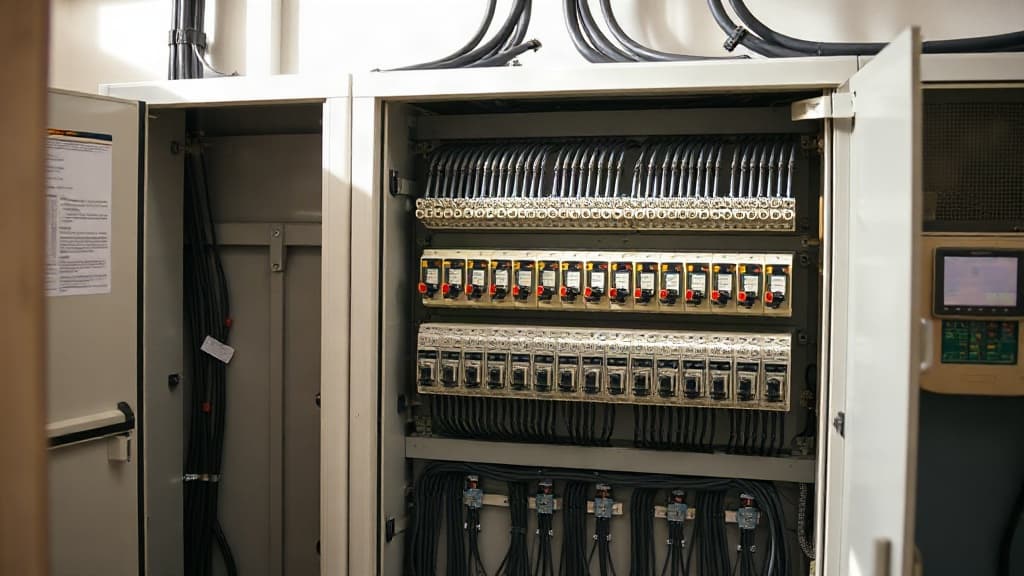
What public buyers purchase
Every public building, network and piece of infrastructure needs cable, protection devices, distribution boards, switches and sockets. Hospitals, schools, universities, social housing bodies, municipalities and transport operators buy them for new buildings, refurbishments and day-to-day maintenance. Energy and water utilities buy too; they purchase under the utilities rules of Directive 2014/25/EU, which also require contract award notices, so their awards appear on TED alongside those of public authorities.
In the Common Procurement Vocabulary the apparatus sits under 31200000 Electricity distribution and control apparatus, with 31210000 Electrical apparatus for switching or protecting electrical circuits and, beneath it, 31212000 Circuit breakers, 31214000 Switchgear and 31214510 Distribution switchboards. Cable is 31300000 Insulated wire and cable, with 31320000 Power distribution cables; wiring accessories include 31224100 Plugs and sockets. Broader supply contracts use 31600000 Electrical equipment and apparatus or 31700000 Electronic, electromechanical and electrotechnical supplies.
Most installation material, however, is bought inside works contracts: 45310000 Electrical installation work, 45311000 Electrical wiring and fitting work or 45317300 Electrical installation work of electrical distribution apparatus. There the award goes to the electrical contractor, who chooses products within the designer's specification. Maintenance stock is often bought through multi-year supply frameworks.
How distribution works
This is a wholesaler-led trade. Electrical wholesalers hold stock of cable, protection devices and accessories across many brands and serve the installers who do the work. Panel builders assemble distribution boards and switchgear from manufacturers' components. Utilities may also run qualification systems under Directive 2014/25/EU, with their own criteria that a supplier must meet before it is admitted.
Award notices show you each layer. Supply awards under 31200000, 31300000 and their sub-codes name the wholesalers and distributors already selling to public buyers. Works awards under 45310000 name the electrical contractors active in each region — the customers a wholesaler will expect your brand to win. Both appear on TED with the winner and the CPV code. Cresques uses that evidence to show who sells a category where; it does not help you bid.
What distributors expect
A wholesaler that lists your products carries them into installations it cannot inspect, so it checks conformity before price:
- CE marking under the Low Voltage Directive 2014/35/EU, which covers equipment rated between 50 and 1 000 V AC and between 75 and 1 500 V DC, and the EMC Directive 2014/30/EU where relevant, with the EU declaration of conformity.
- A RoHS declaration under Directive 2011/65/EU for the electrical and electronic equipment in your range.
- For cable installed permanently in buildings, a declaration of performance and CE marking under the Construction Products Regulation. The harmonised standard is EN 50575, Power, control and communication cables — Cables for general applications in construction works subject to reaction to fire requirements; its co-existence period ended on 1 July 2017. Cables are classed from Aca to Fca under Delegated Regulation (EU) 2016/364, with additional ratings for smoke production, flaming droplets and acidity. The class demanded in a given building is a matter for national rules, so a distributor will ask which classes your range covers. EN 50575 does not cover cables that must assure the continuity of power or signal to safety installations such as alarms, way guidance and firefighting systems.
- Awareness of the new Construction Products Regulation (EU) 2024/3110. It has applied since 8 January 2026, but harmonised standards listed under Regulation (EU) No 305/2011 that were in force on that date remain valid until the Commission withdraws them, and the old rules keep applying to those products in the meantime — at the latest until 8 January 2040. The Commission says the old standards will be replaced as new ones are made mandatory by implementing acts; until that happens for cables, EN 50575 remains the reference.
- Products that fit national installation practice. Plugs and socket outlets for domestic use are outside the Low Voltage Directive, so national systems apply: in the UK, standard plugs must be of a type approved against BS 1363 and contain a BS 1362 fuse. Installation rules across Europe build on the HD 60364 series for low-voltage installations, but each country works to its own wiring rules — in the UK, BS 7671, the IET Wiring Regulations. As of October 2026 we could not confirm a single list of which voluntary national certification marks wholesalers ask for in each country; ask the distributor before quoting.
- Clean product data — article numbers, technical data, drawings and images — that drops into the wholesaler's catalogue and webshop, with stock available in the country and predictable lead times.
- Installer support: training, technical documentation in the local language and a warranty process that works through the wholesaler.
Markets to start with
France. A large public estate and a national network of electrical wholesalers. B2B e-mail to a company's generic address (info@, contact@) needs no consent under CNIL guidance, so a first approach by e-mail is workable; a named professional address needs more (see France).
Germany. A large market where installation material typically moves from manufacturer to wholesaler to installer. E-mail advertising without prior express consent is unlawful, so plan on letters, trade fairs and introductions, and expect a longer sales cycle.
UK and Ireland. The UK publishes above-threshold awards on Find a Tender rather than TED, and its own plug rules and wiring regulations mean that accessories often need UK-specific variants. Unsolicited e-mail to companies is allowed if you identify yourself and give an opt-out. Ireland stays inside the EU regime, so its awards appear on TED, and marketing e-mail to a company is permitted on similar conditions.
Central Europe. Poland, Czechia and Slovakia all publish on TED, but their e-mail rules differ. Poland and Czechia require prior consent for commercial e-mail, companies included, so open with a letter, a fair or an introduction. Slovakia is unsettled: its electronic communications act allows e-mail to a company's published contact details if you identify yourself and every message offers a free, simple opt-out, but its e-commerce act (Act No. 22/2004, § 4(6)) bans commercial e-mail the recipient did not ask for, with no business exception, so a letter or call first is the cautious route.
The industry in numbers
Public supply contracts across 30 European countries, from TED award notices (2023-11 – 2026-11)
- Contracts awarded
- 20.1K
- Awarded value
- €17B
- 69% of awards with a published value
- Won from abroad
- 7.5%
Table view
| Electrical equipment and apparatus | 7,425 |
| Electricity distribution and control apparatus | 5,064 |
| Electronic, electromechanical and electrotechnical supplies | 4,295 |
| Insulated wire and cable | 3,349 |
Questions
- Which CPV codes cover cables, switchgear and wiring accessories in public tenders?
- Apparatus sits under CPV 31200000 Electricity distribution and control apparatus, with 31210000 for switching and protecting devices and 31214510 Distribution switchboards. Cable is 31300000 Insulated wire and cable, with 31320000 Power distribution cables; 31224100 covers plugs and sockets. Much of it is bought inside works contracts under 45310000 Electrical installation work.
- Do building cables need CE marking under the Construction Products Regulation?
- Yes. Power, control and communication cables for construction works that are subject to reaction-to-fire requirements are covered by the harmonised standard EN 50575, whose co-existence period ended on 1 July 2017. The manufacturer issues a declaration of performance with a reaction-to-fire class from Aca to Fca. The class required for a given building is set by national rules.
- What changes with the new Construction Products Regulation (EU) 2024/3110?
- The new Regulation has applied since 8 January 2026, but harmonised standards listed under the old Regulation (EU) No 305/2011 that were in force on that date remain valid until the Commission withdraws them. For cables that means EN 50575 remains the reference until the Commission withdraws it: the new rules apply to a product family one year after the implementing act that makes a new standard mandatory (unless the act sets a later date), and the old reference is withdrawn within a year after that (Article 95(9) and (10)).
- Can one range of sockets be sold across Europe?
- Not as a rule. Plugs and socket outlets for domestic use are outside the Low Voltage Directive, so national systems and rules apply. In the UK, for example, standard plugs must be of a type approved against BS 1363 and contain a BS 1362 fuse.