Heating, ventilation and air conditioning
How public bodies buy heat pumps, boilers, air conditioning and ventilation, why installers and wholesalers carry the brand, and what the F-gas rules change.
Updated 16 October 2026
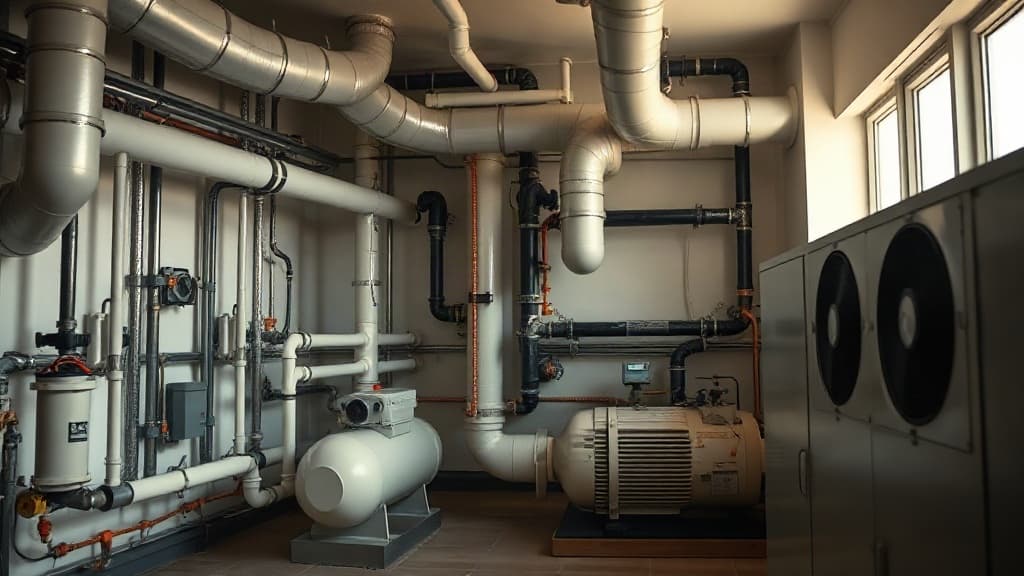
What public buyers purchase
Public estates are large users of heating, cooling and ventilation: schools and universities, hospitals, offices, social housing, sports centres and swimming pools. Equipment is replaced at the end of its life, during energy renovations and when buildings change use. Policy pushes in one direction: the recast Energy Performance of Buildings Directive (EU) 2024/1275 has barred Member States from subsidising stand-alone fossil-fuel boilers since 1 January 2025, and asks their building renovation plans to work towards phasing out fossil-fuel boilers completely by 2040.
In the CPV the equipment sits under 42500000 Cooling and ventilation equipment, with 42511110 Heat pumps, 42512000 Air-conditioning installations and 42520000 Ventilation equipment, alongside 44621000 Radiators and boilers, 44622000 Heat-recovery systems and 39715200 Heating equipment. The supply codes are only half the picture. Much HVAC equipment is bought inside works contracts under 45331000 Heating, ventilation and air-conditioning installation work, where the award goes to the installer.
How distribution works
HVAC is an installer-led trade. The mechanical contractor that wins a works contract proposes equipment within the consulting engineer's specification, buys it from a heating and plumbing wholesaler or a specialist HVAC distributor, installs it and commissions it. Distributors hold stock, provide technical support and training, and sometimes carry a manufacturer's range exclusively for a territory.
Award notices are therefore useful in two ways. Supply awards under the equipment codes name the distributors and suppliers already selling to public buyers. Works awards under 45331000 name the installers active in a region — the customers a distributor will expect you to help it win. Both appear on TED with the winner and the CPV code. Cresques uses that evidence to show who sells a category where; it does not help you bid.
What distributors expect
- Conformity for each product: CE marking under the Low Voltage Directive 2014/35/EU and the EMC Directive 2014/30/EU for domestic electrical equipment, and usually under the Machinery Directive 2006/42/EC for commercial air-handling units, chillers and heat pumps (the Machinery Regulation (EU) 2023/1230 from 20 January 2027; the Low Voltage Directive carve-out covers only household appliances for domestic use and a few other groups, Article 1(2)(k)), plus RoHS and, where it applies, the Pressure Equipment Directive 2014/68/EU, and for gas-fired boilers an EU type-examination by a notified body under the Gas Appliances Regulation (EU) 2016/426.
- Ecodesign and energy-label data. Boilers and hydronic heat pumps up to 400 kW fall under ecodesign Regulation (EU) No 813/2013, with an energy label under Regulation (EU) No 811/2013 up to 70 kW; air conditioners up to 12 kW and ventilation units have their own rules, Regulations (EU) No 206/2012 and No 1253/2014. Before a new labelled model is placed on the market, the supplier must enter it in the EU product database. Several of these rules are being revised.
- A refrigerant roadmap. The F-gas Regulation (EU) 2024/573 cuts the quantity of HFCs that may be placed on the EU market to zero from 2050, and bans many air-conditioning and heat-pump products that use high-warming gases on dates set per product type. From 1 January 2027, for example, self-contained air conditioners and heat pumps up to 12 kW, and split air-to-water systems up to 12 kW, may not be placed on the market with gases of a global-warming potential of 150 or more, with limited exceptions where safety requirements at the site rule out lower-potential gases. A distributor stocking for a multi-year framework will check your range against those dates.
- Installer support: training, commissioning help, a technical hotline in the local language, spare parts held in the country, and warranty terms that work through the installer.
- Selection data and design files: performance at the conditions local consultants specify, sound data, and objects for the design software they use.
Markets to start with
France. A public estate served by an established network of heating and plumbing wholesalers. B2B e-mail to a company's generic address (info@, contact@) needs no consent under CNIL guidance, so a first approach by e-mail is workable; a named professional address needs more (see France).
Germany. A market with a strong installer trade, where equipment typically moves from manufacturer to wholesaler to installer. E-mail advertising without prior express consent is unlawful, so plan on letters, trade fairs and introductions.
UK and Ireland. The UK publishes above-threshold awards on Find a Tender rather than TED, and Great Britain applies its own list of F-gas bans, so check the GB dates separately from the EU ones. Unsolicited e-mail to companies is allowed if you identify yourself and give an opt-out. Ireland stays inside the EU regime, so its awards appear on TED.
Netherlands. A compact market with demanding sustainability specifications. Unsolicited commercial e-mail requires prior consent, including for businesses, unless the company has published an address specifically for receiving such offers, so the first contact is by post, at a fair or through an introduction.
Nordics. Sweden, Denmark and Finland publish on TED as EU members and Norway does so through the EEA, so the same evidence is available. Check each country's rules on commercial e-mail before writing.
The industry in numbers
Public supply contracts across 30 European countries, from TED award notices (2023-11 – 2026-11)
- Contracts awarded
- 13.5K
- Awarded value
- €5.2B
- 68% of awards with a published value
- Won from abroad
- 3.7%
- Domestic appliances4,649
Table view
| Tanks, reservoirs and containers; central-heating radiators and boilers | 5,232 |
| Domestic appliances | 4,649 |
| Cooling and ventilation equipment | 3,628 |
Questions
- Which CPV codes cover heat pumps, boilers and ventilation in public procurement?
- The equipment sits under 42500000 Cooling and ventilation equipment, with 42511110 Heat pumps, 42512000 Air-conditioning installations and 42520000 Ventilation equipment, alongside 44621000 Radiators and boilers, 44622000 Heat-recovery systems and 39715200 Heating equipment. Much HVAC equipment is bought inside works contracts under 45331000 Heating, ventilation and air-conditioning installation work, where the award goes to the installer.
- Who wins public HVAC contracts in Europe, installers or distributors?
- Both, in different notices. Supply awards under the equipment codes name the distributors and suppliers already selling to public buyers, while works awards under 45331000 name the installers active in a region. The mechanical contractor that wins a works contract usually buys the equipment from a heating and plumbing wholesaler or a specialist HVAC distributor.
- Which EU rules apply to heat pumps, boilers and air conditioners?
- CE marking — for domestic units under the Low Voltage Directive 2014/35/EU and the EMC Directive 2014/30/EU, for commercial air-handling units, chillers and heat pumps usually under the Machinery Directive 2006/42/EC (the Machinery Regulation (EU) 2023/1230 from 20 January 2027), plus RoHS and, where it applies, the Pressure Equipment Directive 2014/68/EU — EU type-examination under Regulation (EU) 2016/426 for gas-fired boilers, ecodesign and energy-label rules for each product group, and the F-gas Regulation (EU) 2024/573. From 1 January 2027, for example, self-contained air conditioners and heat pumps up to 12 kW, and split air-to-water systems up to 12 kW, may not be placed on the market with gases of a global-warming potential of 150 or more, with limited exceptions for safety.
- What do HVAC distributors expect from a new manufacturer?
- Conformity and ecodesign data for every product and a refrigerant roadmap that fits the F-gas dates. They also want installer support — training, commissioning help, a technical hotline in the local language, spare parts held in the country and warranty terms that work through the installer — plus selection data and design files for the software local consultants use.