Commercial kitchen and catering equipment
How schools, hospitals and other public kitchens buy catering equipment, the dealers and kitchen contractors that win it, and the safety rules they check first.
Updated 16 October 2026
What public buyers purchase
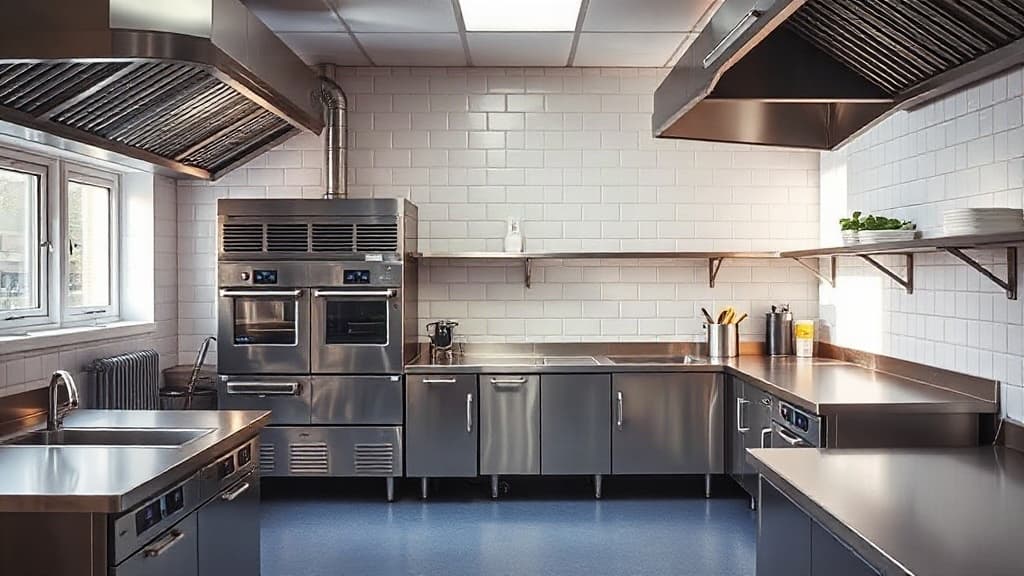
Public catering runs every day: school canteens and central production kitchens, hospital and care-home kitchens, prisons, the armed forces, universities and staff restaurants. These kitchens buy cooking equipment (combination ovens, ranges, tilting pans, fryers), food-preparation machines, refrigeration, warewashing, serving counters and the smallwares that go with them.
In the CPV the core codes are 39310000 Catering equipment, with 39312000 Food-preparation equipment, 39314000 Industrial kitchen equipment and 39315000 Restaurant equipment, together with 42341000 Commercial ovens, 42959000 Non-domestic dishwashing machines and 42513290 Commercial refrigerating equipment. Equipment is bought as single items, through multi-year frameworks for replacement, and inside fit-out works when a kitchen is built or refurbished; maintenance is often tendered separately under 50883000 Repair and maintenance services of catering equipment. In France, UGAP, the national central purchasing body, has a professional catering range that public buyers can order from without running a procedure of their own.
How distribution works
The winners are mostly catering equipment dealers and kitchen design-and-install contractors. They draw the kitchen, specify a mix of brands, coordinate gas, power, water and extraction, install and commission, and then often hold the service contract. Many dealers employ their own engineers or work with service companies, because in a kitchen that serves every day, uptime matters as much as price. Manufacturers with a strong local subsidiary sell direct on large projects, but much of the volume moves through dealers.
For a manufacturer, the dealers that keep winning catering lots for school districts or hospital groups are the partners to find. Award notices on TED name the supplier or contractor and carry the CPV code, so that pattern is visible without local contacts.
What distributors expect
Dealers put their name on the installation, so they check safety and service before price:
- CE marking under the Low Voltage Directive 2014/35/EU and the EMC Directive 2014/30/EU for ovens, refrigeration and other electrical equipment. Food-preparation machines such as mixers and slicers fall under the machinery rules instead of the Low Voltage Directive (the machinery rules cover their electrical safety too), plus EMC: the Machinery Directive 2006/42/EC is replaced by the Machinery Regulation (EU) 2023/1230 from 20 January 2027, so expect questions on which regime your documentation follows.
- For gas-fired equipment, EU type-examination by a notified body under the Gas Appliances Regulation (EU) 2016/426, with instructions and safety information in the language the Member State requires.
- Food-contact compliance under Regulation (EC) No 1935/2004 for surfaces and parts that touch food.
- Energy and refrigerant data for refrigeration. Professional refrigerated storage cabinets carry an energy label under Delegated Regulation (EU) 2015/1094 and must meet ecodesign Regulation (EU) 2015/1095. Under the F-gas Regulation (EU) 2024/573, self-contained commercial refrigerators and freezers have been banned with HFCs of a global-warming potential of 150 or more since 1 January 2022, and with other fluorinated gases of 150 or more since 1 January 2025, with no safety exemption; since 2025 the ban also covers other self-contained refrigeration equipment (except chillers) with fluorinated gases of 150 or more, unless safety requirements at the site of operation demand them (Annex IV, points 3 and 4).
- Service support: spare parts held in the country, training for the dealer's engineers, and service manuals and parts lists in the local language.
- Planning data: CAD symbols and utility connection details for kitchen designers, and lead times that fit the short windows, such as school holidays, in which public kitchens can close.
Markets to start with
France. A public catering sector with school and central production kitchens, UGAP as a national route and an established dealer network. B2B e-mail to a company's generic address (info@, contact@) needs no consent under CNIL guidance, so a first approach by e-mail is workable; a named professional address needs more (see France).
Germany. A market spanning schools, hospitals and staff canteens, served by a well-organised specialist dealer trade. E-mail advertising without prior express consent is unlawful, so plan on letters, trade fairs and introductions, and expect a longer sales cycle.
UK and Ireland. The UK publishes above-threshold awards on Find a Tender rather than TED. Great Britain recognises CE marking for a range of product regulations, including low-voltage equipment, EMC, machinery and gas appliances; check the current position for your product, particularly for machinery once the EU Machinery Regulation applies. Unsolicited e-mail to companies is allowed if you identify yourself and give an opt-out. Ireland stays inside the EU regime, so its awards appear on TED.
Netherlands. A compact market with demanding sustainability specifications. Unsolicited commercial e-mail requires prior consent, including for businesses, unless the company has published an address specifically for receiving such offers, so the first contact is by post, at a fair or through an introduction.
Nordics. Sweden, Denmark and Finland publish on TED as EU members and Norway does so through the EEA, so the same evidence is available. Check each country's rules on commercial e-mail before writing.
The industry in numbers
Public supply contracts across 30 European countries, from TED award notices (2023-11 – 2026-11)
- Contracts awarded
- 29.3K
- Awarded value
- €8.3B
- 69% of awards with a published value
- Won from abroad
- 3.7%
- Furnishing12,877
Table view
| Furnishing | 12,877 |
| Miscellaneous general and special-purpose machinery | 9,073 |
| Cooling and ventilation equipment | 3,628 |
| Miscellaneous equipment | 3,179 |
| Industrial or laboratory furnaces, incinerators and ovens | 591 |
Questions
- Which CPV codes cover commercial kitchen and catering equipment?
- The core codes are 39310000 Catering equipment, with 39312000 Food-preparation equipment, 39314000 Industrial kitchen equipment and 39315000 Restaurant equipment, together with 42341000 Commercial ovens, 42959000 Non-domestic dishwashing machines and 42513290 Commercial refrigerating equipment. Maintenance is often tendered separately under 50883000 Repair and maintenance services of catering equipment.
- Who wins public catering equipment contracts in Europe?
- Mostly catering equipment dealers and kitchen design-and-install contractors. They draw the kitchen, specify a mix of brands, install and commission, and then often hold the service contract. Manufacturers with a strong local subsidiary sell direct on large projects, but much of the volume moves through dealers.
- Which EU rules apply to commercial catering equipment?
- CE marking under the Low Voltage Directive 2014/35/EU and the EMC Directive 2014/30/EU for ovens, refrigeration and other electrical equipment; for food-preparation machines such as mixers and slicers, the machinery rules (which also cover their electrical safety) plus EMC, with the Machinery Regulation (EU) 2023/1230 replacing Directive 2006/42/EC from 20 January 2027; EU type-examination under Regulation (EU) 2016/426 for gas-fired equipment; and Regulation (EC) No 1935/2004 for parts that touch food. Refrigeration adds energy-label, ecodesign and F-gas requirements.
- What do catering equipment dealers expect from a new manufacturer?
- Safety and service before price: conformity documentation, spare parts held in the country, training for the dealer's engineers, and service manuals and parts lists in the local language. Kitchen designers also need CAD symbols and utility connection details, and lead times that fit the short windows, such as school holidays, in which public kitchens can close.