Workwear and PPE
How public employers buy workwear and protective equipment, the safety distributors that win those contracts, and the certificates they will ask for first.
Updated 16 October 2026
What public buyers purchase
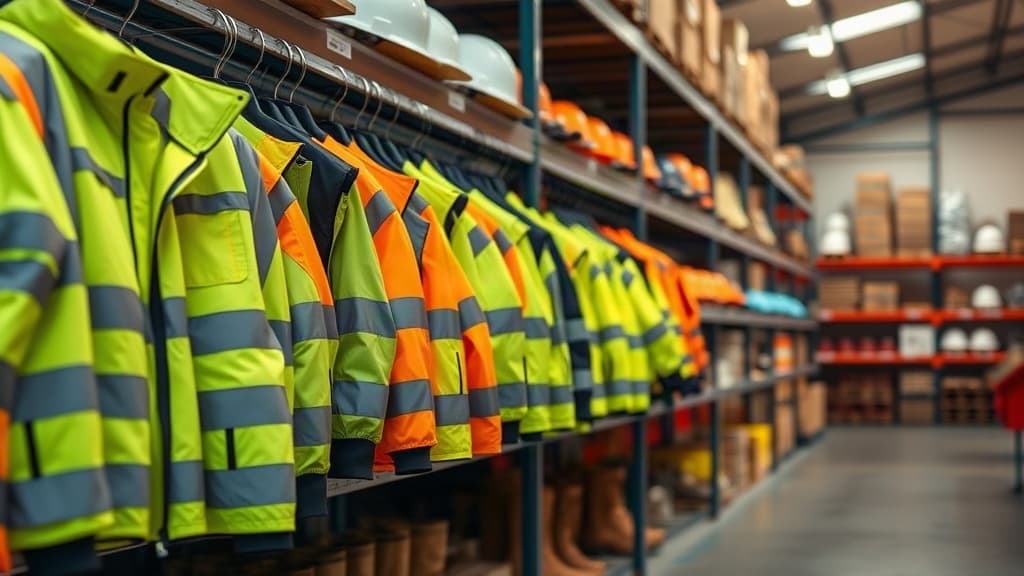
Public employers clothe a lot of people: refuse and street-cleaning crews, parks and highways teams, water and energy utilities, railways, airports, hospitals, prisons, police and fire services, the armed forces. Their purchases divide into everyday workwear (trousers, jackets, polo shirts, uniforms), personal protective equipment (gloves, safety footwear, helmets, eye and hearing protection, high-visibility garments) and specialist kit for fire, chemical or electrical risks.
In the CPV the core codes are 18100000 Occupational clothing, special workwear and accessories, with 18110000 Occupational clothing and 18130000 Special workwear beneath it, 18143000 Protective gear, 18424000 Gloves, 18444000 Protective headgear, 18830000 Protective footwear and 35113400 Protective and safety clothing. Contracts are usually multi-year frameworks by lot — footwear in one lot, hi-vis in another — and increasingly bundle services: sizing, personalisation with the employer's identity, managed stock, and for some garments laundering and repair.
How distribution works
The companies that win these frameworks are mostly safety and workwear distributors. They carry several manufacturers' brands, hold stock across the size range, run the fitting sessions, embroider or print the employer's identity, and operate the ordering portal the buyer's staff use. Rental and laundry service companies compete for the garment lots where the buyer prefers a service model. Manufacturers sell direct mainly to very large employers or through their own branded ranges where the brand itself is specified.
A manufacturer therefore needs the distributors who already supply the public employers in a country. Award notices on TED name those winners and show the category, so the distributors that keep winning protective footwear or hi-vis frameworks in a region are identifiable from the public record.
What distributors expect
Distributors live by their catalogue and their stock. Before they list a new manufacturer they will ask for:
- Conformity under Regulation (EU) 2016/425, which sets the requirements for the design and manufacture of PPE made available in the EU. Category II products need EU type-examination (module B) by a notified body, and Category III products also need ongoing notified-body surveillance of production (module C2 or D, Article 19), so have both certificates, the EU declaration of conformity and the user information ready in the local language.
- Performance against the standards buyers specify, for example ISO 20471 for high-visibility clothing and ISO 20345 for safety footwear, with test reports a buyer can check against a tender.
- A full and stable size range, with continuity of supply for the life of a framework; a garment that disappears mid-contract costs the distributor the lot.
- Capacity for personalisation and short re-order lead times, because most orders are replenishment.
- Clean product data (EAN, sizes, colours, care instructions) that drops into the distributor's portal.
- A margin and territory arrangement that respects the distributor's existing brands, and a clear policy on who serves which accounts.
For Great Britain, the UK government has extended recognition of the CE marking indefinitely for a range of product regulations, so CE-marked PPE can continue to be placed on the GB market; the UK's own PPE regulations still apply, and a distributor will expect you to know the detail.
Markets to start with
France. Large public employers, well-organised safety distributors and hospital purchasing groups. B2B e-mail to a company's generic address (info@, contact@) needs no consent under CNIL guidance, so a first approach by e-mail with the certificates attached is realistic.
Germany. A market with a strong occupational-safety culture and a specialised distributor landscape. E-mail advertising without prior express consent is unlawful; letters, safety trade fairs and introductions are the way in.
UK and Ireland. The UK publishes above-threshold awards on Find a Tender rather than TED. Unsolicited e-mail to companies is permitted if you identify yourself and provide an opt-out. Ireland remains inside the EU regime and appears on TED.
Netherlands. A compact market with a few strong distributors and service providers. Unsolicited commercial e-mail requires prior consent, also from businesses, so start with post, a fair or an introduction.
Nordics. Demanding climates, high safety expectations and award notices on TED for Sweden, Denmark, Finland and Norway (Norway through the EEA). Check each country's rules on commercial e-mail before writing.
The industry in numbers
Public supply contracts across 30 European countries, from TED award notices (2023-11 – 2026-11)
- Contracts awarded
- 28.2K
- Awarded value
- €9B
- 62% of awards with a published value
- Won from abroad
- 2.7%
- Footwear2,843
Table view
| Emergency and security equipment | 10,010 |
| Occupational clothing, special workwear and accessories | 9,231 |
| Special clothing and accessories | 6,151 |
| Footwear | 2,843 |
Questions
- Which CPV codes cover workwear and PPE in public tenders?
- The core codes are 18100000 Occupational clothing, special workwear and accessories, with 18110000 and 18130000 beneath it, plus 18143000 Protective gear, 18424000 Gloves, 18444000 Protective headgear, 18830000 Protective footwear and 35113400 Protective and safety clothing.
- What certificates do PPE distributors in Europe ask for?
- Conformity under Regulation (EU) 2016/425: Category II products need EU type-examination by a notified body, and Category III products (such as chemical, fall-arrest or live-working PPE) also need ongoing notified-body surveillance of production (module C2 or D), plus the EU declaration of conformity and user information in the local language. Distributors also expect test reports against the standards buyers specify, such as ISO 20471 for high-visibility clothing and ISO 20345 for safety footwear.
- Can CE-marked PPE be sold in Great Britain?
- The UK government has extended recognition of the CE marking indefinitely for a range of product regulations, so CE-marked PPE can continue to be placed on the GB market. The UK's own PPE regulations still apply, and a distributor will expect you to know the detail.