Cleaning and hygiene products
How hospitals, schools and councils buy cleaning chemicals, paper hygiene, dispensers and disinfectants, who supplies them, and the EU rules that apply.
Updated 16 October 2026
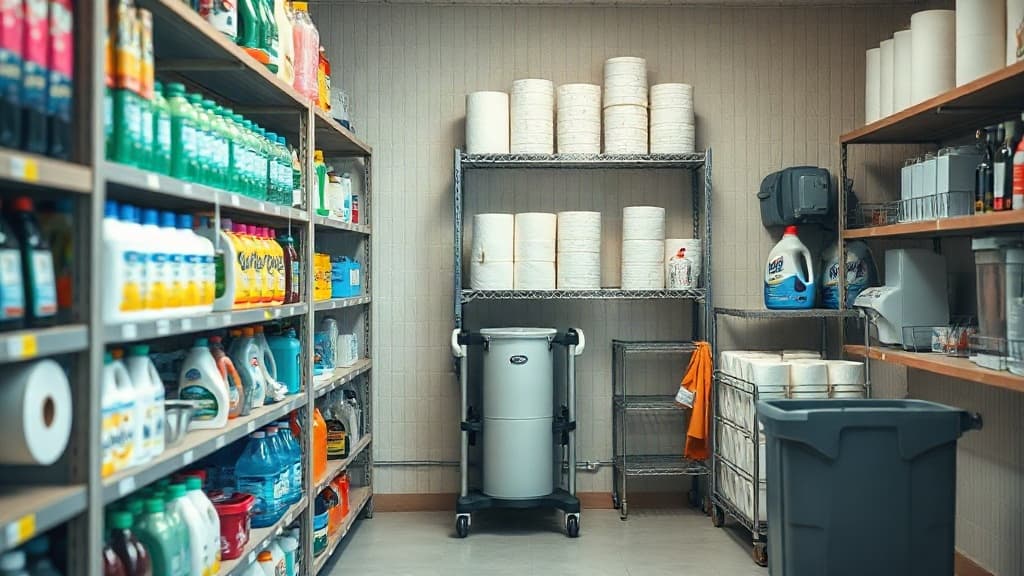
What public buyers purchase
Public buildings are cleaned every day, so public bodies buy hygiene products continuously: floor and surface cleaners, washroom and kitchen detergents, disinfectants for hospitals and care homes, hand soap and sanitiser, toilet paper and hand towels, dispensers, bin liners, mops, brushes and cleaning machines. In the CPV the core codes are 39800000 Cleaning and polishing products, 39830000 Cleaning products and 39831200 Detergents, with 24455000 Disinfectants, 33760000 Toilet paper, handkerchiefs, hand towels and serviettes (33763000 for paper hand towels) and 39224000 Brooms and brushes and other articles of various types. Dispensers have their own codes, such as 39831700 Automatic soap dispensers and 42968300 Toilet-roll dispenser system.
Many of these products are never bought directly by the public body. When cleaning is outsourced, the contractor supplies the chemicals and sometimes the washroom consumables, and the contract is coded as a service under 90910000 Cleaning services. In the UK, the Government Commercial Agency's Facilities Management and Workplace Services agreement (RM6232), open to all public sector organisations, includes routine and reactive cleaning among its services. Where products are bought directly, buyers can use a central purchasing body: in France, UGAP, the national central purchasing body, has a hygiene and cleaning range that public buyers can order from without running a procedure of their own. Hospitals, schools and municipalities also tender their own supply frameworks, often split into lots for chemicals, paper and dispensers.
How distribution works
Two kinds of company carry most of this business. Janitorial and hygiene wholesalers stock chemicals, paper, dispensers and equipment from many manufacturers and deliver to buildings or to cleaning contractors. Facility-management and cleaning contractors buy those products to run their service contracts, and often decide which brands are used on site. Dispensers matter more than they look: many are designed to take a particular refill, so whoever installs them is well placed to supply the paper or soap afterwards.
Award notices show both layers. Supply awards under the product codes name the wholesalers that win hospital, school and council lots; service awards under 90910000 name the cleaning contractors active in a region, which are the customers a wholesaler will expect your brand to help it win. On TED both carry the winner and the CPV code. Cresques shows who already sells a category in a country, from that public evidence; it does not help you bid.
What distributors expect
Cleaning chemicals are regulated as chemicals, as detergents and, for disinfectants, as biocides, so the documentation comes first:
- Detergent compliance. Under the Detergents Regulation (EC) No 648/2004, the manufacturer, a term that includes the importer, must be established in the EU; surfactants must meet the biodegradability criteria; labels must carry the information set out in Article 11 and Annex VII; and an ingredient data sheet must be made available to medical personnel on request. Regulation (EU) 2026/405 replaces it from 23 September 2029, adding digital labelling, a digital product passport and rules for refill sales. Detergents placed on the market before that date in line with the old rules may stay on sale.
- Classification, labelling and safety data sheets. Mixtures are classified and labelled under the CLP Regulation (EC) No 1272/2008, which Regulation (EU) 2024/2865 amended, among other things with minimum label and font sizes; Regulation (EU) 2025/2439 deferred those label-formatting rules, including the font sizes, to 1 January 2028, so check which version your labels follow. Where REACH requires a safety data sheet, it must be supplied in an official language of the country where the product is placed on the market.
- Biocide authorisation for disinfectants. Hand disinfectants (product-type 1), surface disinfectants (product-type 2) and food-area disinfectants (product-type 4) are biocidal products under Regulation (EU) No 528/2012 and may only be made available once authorised. For up to three years after the last of a product's active substances is approved, Member States may keep their national systems (Article 89(2), as amended by Regulation (EU) No 334/2014). Since 1 September 2015, a biocidal product may not be made available unless the supplier of its active substance, or where relevant the product's importer, is on the list kept by the European Chemicals Agency. Labels may not use claims such as "non-toxic", "harmless", "natural" or "environmentally friendly", and Member States may require labels in their official languages.
- Ecolabel evidence. There are EU Ecolabels for hard surface cleaning products (Decision (EU) 2017/1217, extended to 31 December 2026) and for tissue paper (Decision (EU) 2019/70). Cleaning contractors holding the EU Ecolabel for indoor cleaning services (Decision (EU) 2018/680) must ensure that at least half of the cleaning products they use each year, measured by volume at purchase, carry the EU Ecolabel or another ISO type I label, which pulls ecolabelled products through the contractor channel. The Commission also publishes EU GPP criteria for indoor cleaning services (2018).
- Electrical dispensers. Sensor-operated soap and towel dispensers are electrical and electronic equipment, so the RoHS Directive 2011/65/EU and the WEEE Directive 2012/19/EU apply, along with the EU declaration of conformity for the CE marking.
- Practical support: product data and dilution rates in the local language, dosing equipment and training for contractors' staff, and clear terms on who owns installed dispensers and who supplies the refills.
Markets to start with
France. UGAP's hygiene and cleaning range, hospital groups and local authorities, served by hygiene wholesalers and cleaning contractors. B2B e-mail to a company's generic address (info@, contact@) needs no consent under CNIL guidance, so a first approach by e-mail is workable; a named professional address needs more (see France).
Germany. Hospitals, schools and municipalities buy directly and through cleaning contractors. E-mail advertising without prior express consent is unlawful, so plan on letters, trade fairs and introductions.
UK and Ireland. Public bodies can buy cleaning through facilities-management agreements such as RM6232, and the UK publishes above-threshold awards on Find a Tender rather than TED. Unsolicited e-mail to companies is allowed if you identify yourself and give an opt-out. Ireland stays inside the EU regime, so its awards appear on TED.
Netherlands. Unsolicited commercial e-mail requires prior consent, including for businesses, unless the company has published an address specifically for receiving such offers, so the first contact is by post, at a fair or through an introduction.
Nordics. Sweden, Finland and Denmark publish on TED as EU members and Norway does so through the EEA. Sweden and Finland allow e-mail to companies if every message offers an opt-out; Norway allows it to a company's general address but not to an employee's own; Denmark requires prior consent, including for businesses.
The industry in numbers
Public supply contracts across 30 European countries, from TED award notices (2023-11 – 2026-11)
- Contracts awarded
- 57.5K
- Awarded value
- €9.5B
- 63% of awards with a published value
- Won from abroad
- 2%
- Personal care products19,157
- Furnishing12,877
Table view
| Personal care products | 19,157 |
| Furnishing | 12,877 |
| Cleaning and polishing products | 11,925 |
| Miscellaneous general and special-purpose machinery | 9,073 |
| Fertilisers and nitrogen compounds | 4,501 |
Questions
- Which CPV codes cover cleaning and hygiene products in public tenders?
- The core codes are 39800000 Cleaning and polishing products, 39830000 Cleaning products and 39831200 Detergents, with 24455000 Disinfectants, 33760000 Toilet paper, handkerchiefs, hand towels and serviettes, 39224000 Brooms and brushes and other articles of various types, and dispenser codes such as 39831700 Automatic soap dispensers and 42968300 Toilet-roll dispenser system.
- Do disinfectants need an authorisation before they can be sold in the EU?
- Yes. Surface, hand and food-area disinfectants are biocidal products under Regulation (EU) No 528/2012 and may only be made available once authorised, although Member States may keep their national systems while the product's active substances are still under review. Since 1 September 2015, the active-substance supplier or the product importer must also be on the list kept by the European Chemicals Agency.
- What is changing in EU detergent rules?
- Regulation (EU) 2026/405 on detergents and surfactants replaces Regulation (EC) No 648/2004 from 23 September 2029. It adds digital labelling, a digital product passport and rules for refill sales. Detergents placed on the market before that date in line with the old regulation may continue to be sold.
- Who supplies cleaning products to public buyers?
- Janitorial and hygiene wholesalers that carry many manufacturers' ranges, and facility-management and cleaning contractors that buy products to run their service contracts. Award notices show both: supply awards name the wholesalers, and cleaning-service awards name the contractors active in a region.